


Oracle 1Z1-082 Questions and Answers Guarantee you Oass the Test Easily
Share Latest 1Z1-082 DUMP with 145 Questions and Answers
NEW QUESTION # 27
In your data center, Oracle Managed Files (OMF) is used for all databases.
All tablespaces are smallfile tablespaces.
SALES_Q1 is a permanent user-defined tablespace in the SALES database.
Examine this command which is about to be issued by a DBA logged in to the SALES database:
ALTER TABLESPACE sales_q1 ADD DATAFILE;
Which are two actions, either one of which you could take to ensure that the command executes successfully? (Choose two.)
- A. Ensure that DB_RECOVERY_FILE_DEST and DB_CREATE_FILE_DEST each specify with at least 50 Mb of available space.
- B. Ensure that DB_CREATE_FILE_DEST specifies a location with at least 100 Mb of available space.
- C. Ensure that DB_RECOVERY_FILE_DEST and DB_CREATE_FILE_DEST each specify locations with at least 50 Mb of available space.
- D. Add the AUTOEXTEND ON clause with NEXT set to 100M.
- E. Specify a path in the DATAFILE clause of the command specifying a location with at least 100M of available space.
Answer: B,E
NEW QUESTION # 28
Examine the description of the PROMOTIONS table: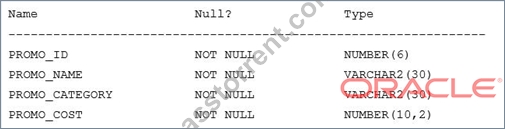
You want to display the unique promotion costs in each promotion category.
Which two queries can be used? (Choose two.)
- A. SELECT promo_category, DISTINCT promo_cost FROM promotions ORDER BY 2;
- B. SELECT promo_cost, promo_category FROM promotions ORDER BY 1;
- C. SELECT DISTINCT promo_cost || ' in ' || DISTINCT promo_category FROM promotions ORDER BY 1;
- D. SELECT DISTINCT promo_category || ' has ' || promo_cost AS COSTS FROM promotions ORDER BY 1;
- E. SELECT DISTINCT promo_category, promo_cost FROM promotions ORDER BY 1;
Answer: A,E
NEW QUESTION # 29
Which two are true about the roles? (Choose two.)
- A. A role must be disabled before it can be revoked from a user.
- B. The SET ROLE statement enables as well as disables roles in a session.
- C. The SET ROLE statement can be used once per session.
- D. The ALTER USER statement must be used to set specific default roles for a user.
- E. All privileges and roles granted to a user are enabled by default when the user logs in.
Answer: B,E
NEW QUESTION # 30
In which three situations does a new transaction always start? (Choose three.)
- A. when issuing a DML statement after a DML statement failed in the same session
- B. when issuing the first Data Manipulation Language (DML) statement after a COMMIT OR ROLLBACK statement was issued in the same session
- C. when issuing a CREATE TABLE statement after a SELECT statement was issued in the same session
- D. when issuing a TRUNCATE statement after a SELECT statement was issued in the same session
- E. when issuing a CREATE INDEX statement after a CREATE TABLE statement completed successfully in the same session
- F. when issuing a SELECT FOR UPDATE statement after a CREATE TABLE AS SELECT statement was issued in the same session
Answer: A,B,F
NEW QUESTION # 31
Which two statements are true about the rules of precedence for operators? (Choose two.)
- A. Arithmetic operators with equal precedence are evaluated from left to right within an expression
- B. NULLS influence the precedence of operators in an expression
- C. Multiple parentheses can be used to override the default precedence of operators in an expression
- D. The + binary operator has the highest precedence in an expression in a SQL statement
- E. The concatenation operator | | is always evaluated before addition and subtraction in an expression
Answer: A,C
Explanation:
Reference:
https://docs.oracle.com/cd/B19306_01/server.102/b14200/operators001.htm
https://docs.oracle.com/cd/A87860_01/doc/server.817/a85397/operator.htm Precedence is the order in which Oracle evaluates different operators in the same expression. When evaluating an expression containing multiple operators, Oracle evaluates operators with higher precedence before evaluating those with lower precedence. Oracle evaluates operators with equal precedence from left to right within an expression.
NEW QUESTION # 32
The INVOICE table has a QTY_SOLD column of data type NUMBER and an INVOICE_DATE column of data type DATE.
NLS_DATE_FORMAT is set to DD-MON-RR.
Which two are true about data type conversions involving these columns in query expressions? (Choose two.)
- A. invoie_date > '01-02-2019' : uses implicit conversion
- B. qty_sold BETWEEN '101' AND '110' : uses implicit conversion
- C. qty_sold = '0554982' uses implicit conversion
- D. CONCAT (qty_sold, invoice_date) : requires explicit conversion
- E. invoice_date = '15-march-2019' : uses implicit conversion
Answer: B,E
NEW QUESTION # 33
Which two are true about shrinking a segment online? (Choose two.)
- A. To shrink a table it must have a PRIMARY KEY constraint
- B. It is not possible to shrink either indexes or Index Organized Tables (IOTs)
- C. To shrink a table it must have a UNIQUE KEY constraint
- D. It always eliminates all migrated rows if any exist in the table
- E. To shrink a table it must have row movement enabled
- F. It must be in a tablespace that uses Automatic Segment Space Management (ASSM)
Answer: E,F
Explanation:
Reference:
https://docs.oracle.com/cd/B19306_01/server.102/b14200/statements_3001.htm
NEW QUESTION # 34
In one of your databases, you create a user, HR, and then execute this command:
GRANT CREATE SESSION TO hr WITH ADMIN OPTION;
Which three actions can HR perform? (Choose three.)
- A. Revoke the CREATE SESSION privilege from user HR
- B. Execute DML statements in the HR schema
- C. Log in to the database instance
- D. Execute DDL statements in the HR schema
- E. Revoke the CREATE SESSION privilege from other users
- F. Grant the CREATE SESSION privilege with ADMIN OPTION to other users
Answer: C,E,F
NEW QUESTION # 35
Which three are types of segments in an Oracle Database? (Choose three.)
- A. index
- B. clusters
- C. sequences
- D. undo
- E. tables
- F. stored procedures
Answer: A,B,E
Explanation:
http://www.adp-gmbh.ch/ora/concepts/segments.html
NEW QUESTION # 36
Which two tasks can you perform using DBCA for databases? (Choose two.)
- A. Configure a nonstandard block size for a new database
- B. Register a new database with an available Enterprise Manager Management server
- C. Configure incremental backups for a new database
- D. Enable flashback database for an existing database
- E. Change the standard block size of an existing database
Answer: A,B
NEW QUESTION # 37
Your database instance was shut down normally and then started in NOMOUNT state. You then execute this command:
ALTER DATABASE MOUNT;
Which two actions are performed? (Choose two.)
- A. The initialization parameter file is read
- B. The online data files are opened
- C. The Oracle background processes are started
- D. The online redo logs are opened
- E. The control file is read
- F. The alert log records the execution details
Answer: E,F
Explanation:
http://facedba.blogspot.com/2014/07/oracle-database-startup-stages-and.html
NEW QUESTION # 38
Which two statements are true about Database Instances and Real Application Clusters (RAC)?
- A. A RAC database can have instances on separate servers.
- B. A RAC database must have three or more Instances.
- C. A RAC database must have two or more instances.
- D. A RAC database can have one Instance.
- E. Two RAC databases can share their instances.
Answer: A,D
NEW QUESTION # 39
Which two statements are true?
- A. SALES1 has not NULL constraints on any selected columns which had those constraints in the sales table.
- B. SALES1 is created with 55,000 rows.
- C. SALES1 is created with no rows.
- D. SALES1 has primary key and unique constraints on any selected columns which had those constraints in the sales table.
- E. SALES1 is created with 1 row.
Answer: A,B
NEW QUESTION # 40
The stores table has a column START_DATE of data type DATE, containing the date the row was inserted. You only want to display details of rows where START_DATE is within the last 25 months. Which where clause can be used?
- A. WHERE TO_XUMBER(start_date - SYSDATE) <= 25
- B. WHERE ADD_MONTHS<start_date, 25) <= SYSDATE
- C. WHERE MON'THS_BETWEEN (start_date, SYSDATE) <= 25
- D. WHERE MON'THS_BETWEEN (SYSDATE, start_date) <= 25
Answer: C
NEW QUESTION # 41
Which two statements are true about the DUAL table? (Choose two.)
- A. It can be accessed only by the SYS user
- B. It can display multiple rows and columns
- C. It can display multiple rows but only a single column
- D. It can be accessed by any user who has the SELECT privilege in any schema
- E. It can be used to display only constants or pseudo columns
- F. It consists of a single row and single column of VARCHAR2 data type
Answer: B,F
Explanation:
Reference:
https://en.wikipedia.org/wiki/DUAL_table
NEW QUESTION # 42
Which two statements are true about the ORDER BY clause when used with a SQL statement containing a SET operator such as UNION? (Choose two.)
- A. Each SELECT statement in the compound query must have its own ORDER BY clause
- B. The first column in the first SELECT of the compound query with the UNION operator is used by default to sort output in the absence of an ORDER BY clause
- C. Column positions must be used in the ORDER BY clause
- D. Only column names from the first SELECT statement in the compound query are recognized
- E. Each SELECT statement in the compound query can have its own ORDER BY clause
Answer: D,E
NEW QUESTION # 43
A script abc.sql must be executed to perform a job.
A database user HR, who is defined in this database, executes this command:
$ sqlplus hr/hr@orcl @abc.sql
What will happen upon execution?
- A. The command fails because the script must refer to the full path name
- B. The command fails and reports an error because @ is used twice
- C. The command succeeds and HR will be connected to the orcl and abc.sql databases
- D. The command succeeds and HR will be connected to the orcl database instance, and the abc.sql script will be executed
Answer: D
NEW QUESTION # 44
In one of your databases, the user HR has the password HRMGR.
You want to connect to a database instance whose listener listens on port 1531 by using this statement:
CONNECT HR/HRMGR@orcl
No name server is used.
Which statement is true about ORCL?
- A. It must resolve to a valid connect descriptor in the server's tnsnames.ora file
- B. It must resolve to a valid connect descriptor in the client's tnsnames.ora file
- C. It must be the name of the database to whose instance HR wishes to connect
- D. It must be the name of the server running the database to whose instance HR wishes to connect
- E. It must be the value of the SERVICE_NAMES parameter on the client side
Answer: D
NEW QUESTION # 45
Examine this command:
CREATE UNDO TABLESPACE undotbs01
DATAFILE `undotbs_01.dbf'
SIZE 100M
AUTOEXTEND ON;
Which two actions must you take to ensure UNDOTBS01 is used as the default UNDO tablespace? (Choose two.)
- A. Add the NOLOGGING clause
- B. Add the SEGMENT SPACE MANAGEMENT AUTO clause
- C. Add the ONLINE clause
- D. Make certain that the database operates in automatic undo management mode
- E. Set UNDO_TABLESPACE to UNDOTBS01
Answer: D,E
NEW QUESTION # 46
Examine this description of the books table containing 100 rows: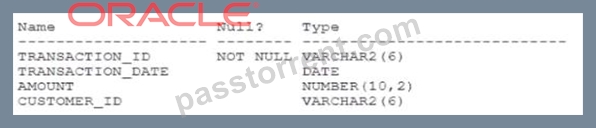
Now examine this sequence of statements Issued In a new session;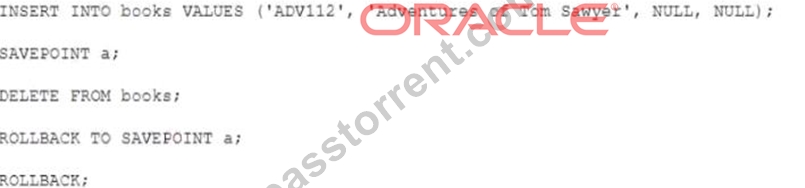
Examine this description of the books table containing 100 rows:
Which three statements are true?
- A. The first RollBack command restores the row that was inserted.
- B. The second rollback command restores the row that was inserted.
- C. The first rollback command leaves the inserted row locked.
- D. The first rollback command restores the 100 rows that were in the table originally.
- E. The second rollback command rolls back the rollback to savepoint a command.
- F. The second rollback command restores the 100 rows that were in the table originally.
- G. The first rollback command leaves the table's 100 original rows locked.
Answer: A,B,E
NEW QUESTION # 47
Which three statements are true about roles?
- A. Roles may be granted to roles.
- B. All roles granted to a user are set on by default when the user logs in,
- C. The SET ROLE statement can enable one or more roles for a session.
- D. Object privileges may not be granted to roles.
- E. The SET ROLE statement can disable one or more roles for a session.
- F. Roles must be password protected.
Answer: A,D,E
NEW QUESTION # 48
The sales table has columns prod_id and quantity_sold of data type number In two queries execute successfully? x
- A. SELECT COUNTlprod_id> FROM sales GROUP BY prod_id WHERE quantity_Sold > 55000;
- B. SELECT prod_id FROM sales WHERE quantity_sold > 55000 GROUP BY prod_id HAVING COUNT(-) > 10;
- C. SELECT prod_id FROM sales WHERE quantity_sold > 5S000 AND COUNT(-) > 10 GROUP BY prod_id HAVING COUNT(-) > 10;
- D. SELECT COUNT|prod_id> FROM sales WHERE quantity_sold > 55000 GROUP BY prod_id;
- E. SELECT prod_id FROM sales WHERE quantity_scld > 55000 AND COUNT(-) > 10 GROUP BY COUNT(-) > 10;
Answer: B,D
NEW QUESTION # 49
Which two statements are true about the DUAL table? (Choose two.)
- A. It can display multiple rows but only a single column
- B. It can be accessed only by the SYS user
- C. It can be accessed by any user who has the SELECT privilege in any schema
- D. It can display multiple rows and columns
- E. It can be used to display only constants or pseudo columns
- F. It consists of a single row and single column of VARCHAR2 data type
Answer: B,F
Explanation:
https://en.wikipedia.org/wiki/DUAL_table
NEW QUESTION # 50
The orders table has a column ORDER_DATE of data type date.
The default display format for a date Is DD-MON-RR.
Which two where conditions demonstrate the correct usage of conversion functions?
- A. WHERE order date > TO DATE('JUL 10 2018', *MON DD YYYY')
- B. WHERE order_date > TO_DATE<ADD_MONTHS(SYSDATE, c) , 'MON DD YYYY')
- C. WHERE TO_CHAR(order_date, 'MON DD YYYY') = 'JAN 20 2019'
- D. WHERE order_date IN (TO_DATE ('Oct 21 2018', 'Mon DD YYYY'), TC_CHAR('Nov 21 2018', 'Mon DD YYYY'))
- E. WHERE order_date > TO_CHAR(ADD_MONTHS(SYSDATE, 6), 'MON DD YYYY')
Answer: A,C
NEW QUESTION # 51
......
Oracle 1Z0-082 exam is a comprehensive exam that covers a wide range of topics related to Oracle database administration. It evaluates the candidate's ability to configure, manage, and maintain an Oracle database, as well as their knowledge of database architecture, backup and recovery, security, and performance tuning. Passing 1Z1-082 exam demonstrates a candidate's expertise in Oracle database administration and their ability to handle complex database environments.
To be eligible for the Oracle 1Z1-082 Certification Exam, candidates must have some experience working with Oracle databases, as well as a basic understanding of SQL. 1Z1-082 exam is intended for individuals who are responsible for managing and maintaining Oracle databases, including database administrators and IT professionals.
Dumps for Free 1Z1-082 Practice Exam Questions: https://freepdf.passtorrent.com/1Z1-082-latest-torrent.html